


 SCHEDULE NOW

We’re deep into a North Texas summer, and you don’t need us to tell you it’s hot. It’s been hot. The long evenings on the patio and the kids in the pool come with a catch: this is the season your home’s electrical system works the hardest it will work all year, and it’s working that hard right now. The air conditioner runs almost nonstop, the pool pump hums along, everybody’s charging everything, and every few weeks a Texas thunderstorm rolls through and reminds the power grid who’s boss. All of that is landing on the wiring, the breakers, and the panel quietly doing their jobs behind your walls, today, in this heat.
Here’s the reassuring part, and we mean it: almost none of this has to be a headache. Most summer electrical problems give you clear warning signs, and nearly all of them are easier and cheaper to handle the moment you notice them rather than after they leave you without AC on a 100-degree afternoon. This guide walks through what a hot Texas summer is asking of your home’s electrical system right now, the signs worth paying attention to, and the upgrades that keep your family cool, safe, and powered up through the rest of it.
We’re Wellott Electric, a family-owned team of licensed electricians based right here in McKinney. Owners Ryan and Megan Wellott built this company on a simple idea: a North Texas family should never feel talked down to by the electrician in their home. That straight-talking, no-pressure approach is how we’ve earned a 5.0 rating across more than 500 Google reviews, and it’s the same honest help you’ll find in this guide.
Grab something cold to drink. The heat’s already here, so let’s make sure your home can handle the rest of it.
What Electrical Problems Are Most Common in the Summer?
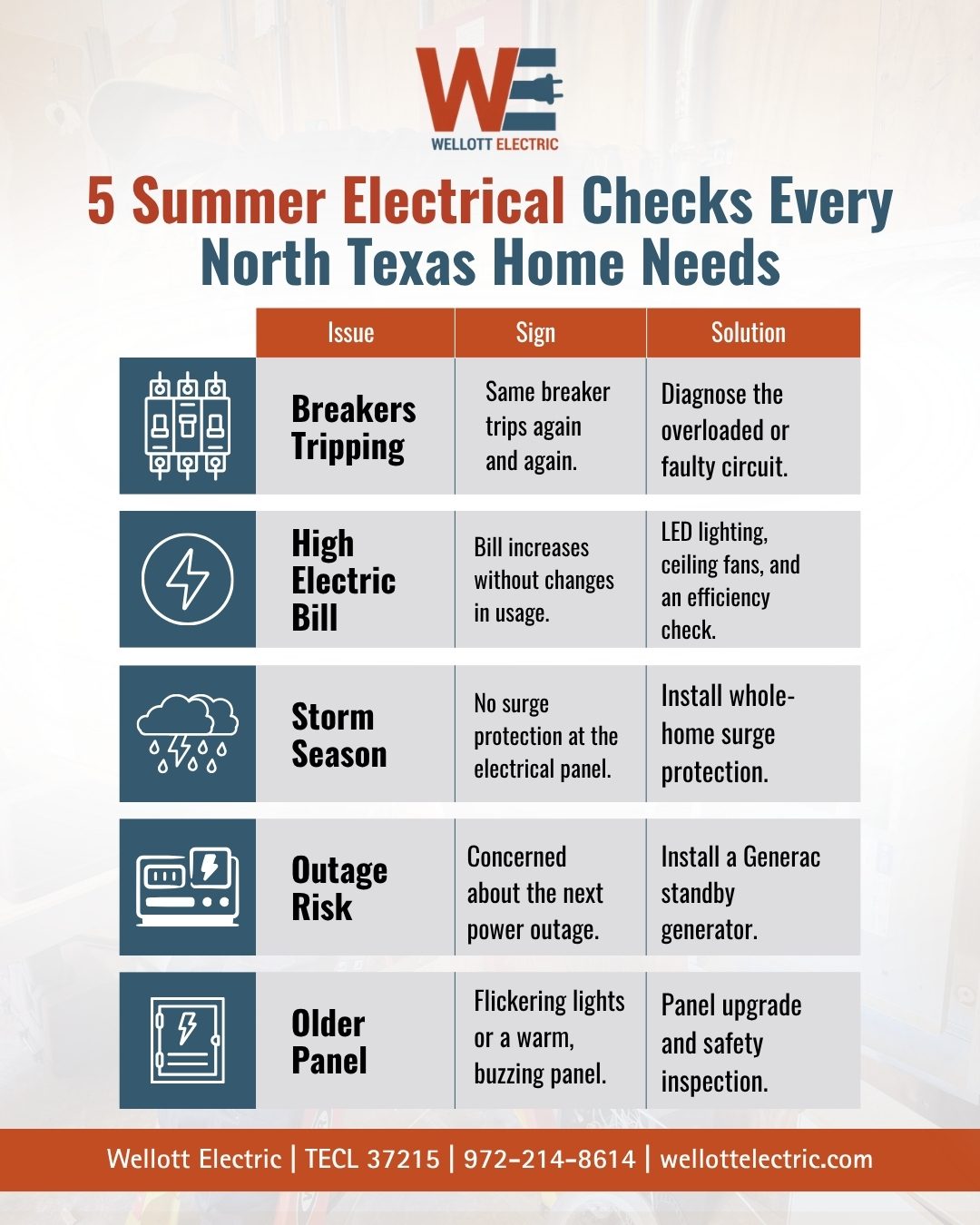
Short answer, for anyone who just wants it: the most common summer electrical issues in North Texas all trace back to two things: heavy air-conditioning load and stormy weather. Heat means breakers trip more often as circuits get pushed to their limit, electric bills climb, and older panels struggle to keep up with modern demand. Storms mean power surges that can quietly damage your electronics, and outages that leave you sweating in the dark. The smartest moves are to catch an overloaded circuit or a tired panel early, protect the home with whole home surge protection in McKinney, and consider backup power before the next storm. If your breakers keep tripping, your bill jumps, or you want to be ready for the next outage, call Wellott Electric at 972-214-8614 or book online.
Here’s the whole guide at a glance, each common summer issue matched with the sign to watch for and the fix. We’ll cover every one of these in detail below.
Why Summer Is the Hardest Season on Your Home’s Electrical System
Think about everything your home’s electricity is doing on a typical July afternoon in McKinney. The air conditioner, by far the biggest electrical load in your house, is running hard to fight a 100-degree day. The pool pump is circulating. The fridge and the garage freezer are working overtime. Someone’s doing laundry, someone else is charging an EV, the kids have every device plugged in, and the whole family is home more than usual. Your electrical panel is quietly routing all of that at once, all day, for months.
That combination of heavy, sustained load and extreme heat is exactly why electrical issues cluster in summer. Wiring and connections run warmer. Circuits that coast through spring get pushed to their limit. And an older or undersized electrical panel, the kind that was plenty for a home built fifteen or twenty years ago, can start showing its age when a modern family’s demand piles on. None of that means anything is wrong with your home. It just means summer is the season your electrical system tells you the truth about whether it’s keeping up.
The good news is that your home gives you signals long before anything becomes a real problem, and a licensed electrician can read those signals and get ahead of them. Consider this your heads-up from a neighbor who has spent a lot of Texas summers in North Texas attics and electrical panels.
How Your Home’s Electrical System Actually Works (A Quick Primer)
Most homeowners live with their electrical system for years without ever really knowing how it works, and that’s completely normal. But a five-minute understanding of the basics makes everything else in this guide click into place, and it helps you make smarter decisions about your home. So here’s the plain-English version, the same way we’d explain it standing at your panel.
Power from the utility reaches your home through the service entrance, passes through your electric meter (the device that measures how much electricity you use), and lands at your main electrical panel, which is the gray metal box in your garage, utility room, or on an exterior wall. The panel is mission control. It takes that incoming power and splits it into individual circuits, each one protected by its own breaker, that fan out to feed the outlets, lights, and appliances throughout your home.
What a circuit is, and why it matters
A circuit is simply one loop of wire that carries power to a group of outlets or a specific appliance and back. Each circuit is rated to carry a certain amount of electrical current, measured in amps. A standard household circuit is usually 15 or 20 amps; big appliances like an electric range, an AC condenser, or an EV charger get their own dedicated higher-amperage circuit, often 240 volts instead of the standard 120. The breaker on each circuit is a safety valve: if that circuit tries to draw more current than the wire is safely rated for, the breaker trips and cuts the power before the wire can overheat. That’s the entire reason breakers exist, and it’s why they matter so much.
Amps, volts, and watts without the headache
Here’s the only electrical math you’ll ever really need. Think of it like water in a hose: volts are the water pressure, amps are how much water is flowing, and watts are the total power doing the work. Volts times amps equals watts. Your whole home is served by a total amperage, commonly 100, 150, or 200 amps, and everything running at once draws from that total. When you understand that your home has a fixed electrical budget and every device spends from it, the rest of this guide, from electrical Panel Upgrade to EV chargers to why your breaker trips on a hot day, suddenly makes complete sense. And the two most important safety systems in that whole setup are proper grounding, which gives stray electricity a safe path away from you, and modern breakers that actually trip when they should. Everything we do protects those fundamentals.
The North Texas Grid, ERCOT, and Your Summer Power
Here’s a piece of the puzzle that’s uniquely Texan, and it’s a big reason summer electrical planning matters more here than almost anywhere else. Most of Texas, including McKinney and the rest of Collin County, runs on its own independent power grid managed by ERCOT, the Electric Reliability Council of Texas. That grid is largely separate from the rest of the country, which has real consequences for you as a homeowner, especially in the dead of summer.
When a brutal heat wave settles over North Texas, millions of air conditioners run flat out at the same time, and demand on the grid climbs toward its limits. You’ve probably seen the conservation alerts asking everyone to bump their thermostats up during peak evening hours. In an extreme event, that strain can lead to outages, and even in a normal summer, the combination of high demand and afternoon thunderstorms makes summer the peak season for lost power in our area. This isn’t meant to alarm you. It’s meant to explain why so many North Texas families treat summer as the season to get their home’s electrical resilience in order.
It also explains why two specific upgrades, whole-home surge protection and standby backup power, have become so popular here specifically. When the grid is stressed and storms are rolling through, the risk of both damaging power surges and outright outages goes up, and a home that’s prepared for both simply rides through the summer while unprepared homes scramble. We’ll cover both in depth below. For now, the takeaway is this: your home’s power doesn’t exist in a vacuum. It’s connected to a grid that works hardest exactly when you need it most, and a little planning goes a long way toward keeping your family comfortable no matter what the Texas summer does.
Why Does My Breaker Keep Tripping in the Summer?
This is one of the most common calls we get once the heat sets in, so let’s clear it up. First, a little reassurance: a breaker that trips is doing exactly what it’s supposed to do. It’s a safety device, and shutting off is how it protects your home from an overloaded or faulty circuit. A breaker that trips once in a while is fine. A breaker that trips over and over is trying to tell you something, and that’s the part worth paying attention to.
In the summer, repeated tripping usually comes down to one of a few things. The most common is simply an overloaded circuit: too many things drawing power at once on the same line, often with a hardworking air conditioner in the mix. Sometimes it’s a specific faulty appliance that’s drawing more than it should. Sometimes it’s a genuine wiring issue, like a short circuit, or a breaker that has simply worn out and no longer holds the way it should. The tricky part is that these all look the same from the outside, which is why the fix starts with figuring out which one you actually have.
Three kinds of breakers, and why the difference matters
Not all breakers are the same, and knowing which kind tripped tells you a lot. A standard breaker protects against overloads and short circuits, the classic ‘too much current’ problem. A GFCI (ground-fault) breaker or outlet, required near water in kitchens, bathrooms, garages, laundry rooms, and outdoors, trips in a fraction of a second if it senses electricity trying to travel somewhere it shouldn’t, like through a person. That’s the ‘test and reset’ button you see on outlets near sinks, and it’s a genuine lifesaver. An AFCI (arc-fault) breaker, now required on many living-area circuits, watches for the tiny dangerous arcs that damaged cords or loose connections create, which are a leading cause of electrical fires. If a GFCI or AFCI device is tripping, it’s often catching a real hazard, not just an overload, which is one more reason repeated tripping deserves a proper look rather than a reset.
How to figure out which circuit is overloaded
You can do a little detective work yourself before you ever call us. When a breaker trips, note what you were running at that moment, especially anything with a motor or a heating element, like a hair dryer, microwave, space heater, window unit, or vacuum. Open your panel and look at the labels (if your circuits aren’t labeled clearly, that’s worth fixing on its own). Try moving one of those high-draw devices to an outlet on a different circuit and see if the tripping stops. If simply spreading the load out solves it, you’ve confirmed an overloaded circuit, and the real fix is usually adding a dedicated circuit for the hungry appliance, or upgrading a panel that’s out of room. If the breaker keeps tripping even with almost nothing plugged in, that points to a faulty breaker or a wiring fault, and that’s the moment to bring in a licensed electrician.
What you should not do
Please don’t just keep resetting a breaker that keeps tripping, and definitely don’t replace it with a higher-amperage breaker to make the problem ‘go away.’ That last one is genuinely dangerous, because the breaker is sized to protect the wire behind it, and forcing more current through than the wire is rated for is how electrical fires start. If a breaker trips repeatedly, the right move is to have a licensed electrician diagnose the cause. It’s usually a straightforward fix once we know what we’re dealing with, and it buys you real peace of mind. Call Wellott Electric at 972-214-8614 or book online at wellottelectric.com, and we’ll sort it out fast.
When Should I Call an Emergency Electrician Right Away?
Most electrical to-dos can wait for a scheduled appointment, but a few genuinely can’t, and knowing the difference matters. Some electrical warning signs point to an immediate fire or shock hazard, and those are the moments to stop what you’re doing and call an emergency electrician right away. Wellott Electric answers the phone 24 hours a day, 7 days a week, so you never have to guess what to do at the moment.
Call for emergency electrical service if you notice any of these
- A burning smell or the smell of hot plastic coming from an outlet, a switch, or the electrical panel. This is one of the most serious warning signs there is, so call immediately.
- Scorch marks, discoloration, or an outlet or panel that’s hot to the touch. Heat where there shouldn’t be heat means stop and call.
- Sparks, buzzing, or crackling from an outlet, switch, or the panel.
- Repeated shocks from outlets, switches, or appliances, even small ones.
- A total loss of power to part or all of the home when the utility isn’t reporting an outage, or a burning smell paired with breakers that won’t reset.
- Any exposed, damaged, or sparking wiring, especially after a storm.
If you’re seeing any of that, don’t try to troubleshoot it yourself. If it’s safe to do so, turn off the affected circuit at the breaker, keep everyone away from the area, and call us. For a genuine emergency in McKinney or anywhere in North Texas, dial 972-214-8614 any hour of the day or night. We offer same-day response for emergencies, and a licensed electrician will get to you quickly, diagnose the problem safely, and give you a written estimate before any repair. When it comes to your family’s safety, calling early is always the right call.
What Is My Summer Electric Bill Trying to Tell Me?
If your electric bill makes you wince every July, you’re in good company, and it’s worth understanding what’s actually driving it. The truth is that the large majority of a North Texas summer bill is your air conditioner, plain and simple. Cooling a home against triple-digit heat is expensive, and no electrician can change the weather. But your electrical setup and habits do influence the rest of the bill, and there are real, practical ways to take some of the sting out of it.
How to actually read your electric bill
Your bill is measured in kilowatt-hours, or kWh, which is just a unit of energy: one kWh is a thousand watts running for one hour. A central AC might pull three to five kWh every hour it runs, which is why cooling dominates a summer bill, while an LED bulb sips a fraction of one. Most Texas retail electricity plans charge a set rate per kWh, so your bill is essentially your total kWh for the month times that rate, plus delivery charges. If you pull up your usage online, most providers show a day-by-day graph, and it’s genuinely eye-opening: you can usually see your usage climb on the hottest days and spike in the late afternoon and evening when the AC is fighting the peak heat. That graph is the single most useful tool for understanding where your money is going.
The hidden loads worth knowing about
Beyond the AC, a few things quietly add up. Pool pumps are one of the largest electricity users in a home and often run far longer than they need to, so a timer adjustment alone can save real money. Older refrigerators and garage freezers work overtime in the heat. And phantom loads, the trickle of power drawn by devices, chargers, and electronics that are ‘off’ but still plugged in, add a small constant drain all month. None of these are emergencies, but together they explain a chunk of the bill that isn’t the air conditioner.
A few of the biggest levers you can actually pull: switching to energy-efficient LED lighting throughout the home uses a fraction of the electricity of old bulbs and puts out far less heat, which your AC will appreciate. Ceiling fans let you feel comfortable at a higher thermostat setting, and every degree you can nudge the thermostat up saves real money over a long Texas summer. Smart lighting, smart switches, and smart plugs help you schedule and stop paying to light and power rooms nobody’s in. And if your bill spikes suddenly with no change in your habits, that’s worth a closer look, because it can point to an aging system or an appliance that’s no longer running efficiently.
We’re not going to promise gimmicks, because that’s not how we work. But a thoughtful lighting and fan plan, done right, genuinely helps you stay comfortable for less, and it’s one of the more satisfying summer projects there is. If you’d like a hand thinking it through, book online at wellottelectric.com or call 972-214-8614. That’s exactly what we’re here for.
Do I Need an Electrical Panel Upgrade? (And What Is a 200-Amp Panel?)
Your electrical panel is the heart of your home’s electrical system, the box that takes power from the utility and distributes it safely to every circuit. And here’s the thing many homeowners don’t realize: the demands we put on a home have grown enormously over the last couple of decades. Central air, EV chargers, hot tubs, home offices, high-powered kitchen appliances, and whole-home everything all pull from that one panel. A panel that was perfectly adequate when the house was built can quietly become the bottleneck as a family’s needs grow.
A quick word on the number you keep hearing, because homeowners ask us about it constantly: amperage. Many older North Texas homes were built with a 100-amp panel, which was plenty at the time. Today, a 200-amp panel upgrade has become the standard for a modern home, because it provides the headroom to run central air, an EV charger, a pool, and everything else at once without maxing out. If you’re planning to add any significant load, a 200-amp service is usually the smart, future-proof foundation, and it’s one of the most common upgrades we install across McKinney and Collin County.
Signs your panel may need attention
There are a few telltale signs worth knowing. Breakers that trip frequently even after you’ve spread the load around. Lights that flicker or dim when the AC kicks on, or a big appliance starts. A panel that feels warm to the touch, buzzes, or shows any scorching or a burning smell (that last one is a call-us-today situation). An older fuse box rather than modern breakers. Or simply a panel from a brand that’s known to be problematic, which a licensed electrician can identify in a glance. If you’re planning to add a major load like an EV charger, a pool, or a generator, that’s also the natural moment to make sure your panel can handle it.
How an electrician decides what size panel you need
This is the part that separates a licensed electrician from a guess, and it’s called a load calculation. Rather than eyeballing it, we add up the real electrical demand of your home following the National Electrical Code: the square footage, the major appliances, the HVAC system, and any big additions like an EV charger or a pool, applying the code’s rules for how much of each is likely to run at once. That calculation tells us honestly whether your existing service has room for what you want to add, or whether an upgrade to a 200-amp panel is the right foundation. It’s why we never just slap a new circuit onto a panel and hope. Doing the math first is how you avoid an overloaded service and a home that trips its main breaker on the hottest day of the year.
A word about older and problem panel brands
If your home was built decades ago, it’s worth knowing that a few panel brands from that era developed a reputation for not tripping reliably, which defeats the entire purpose of a breaker. Federal Pacific (FPE), Zinsco, and a handful of others fall into this category, and many electricians recommend replacing them regardless of age because a breaker that doesn’t trip when it should is a genuine fire risk. You don’t need to diagnose this yourself. During a safety inspection or any service call, we can identify your panel brand in a glance and tell you honestly whether it’s something to keep an eye on or something to address. There’s no alarm here, just information that’s genuinely worth having about your own home.
A panel upgrade isn’t something to fear or rush into, but it is one of the most valuable safety and capacity improvements you can make to a home, especially now that a hot Texas summer is already stacking peak demand on top of a growing electrical appetite. When we upgrade a panel, we handle the load calculation, the premium panel install, proper grounding to code, the city permit, coordination with the power company, and the final inspection. And because our pricing is flat and transparent, you get a written price before any work begins, with the permit and inspection included in the estimate. No hourly meter running, no surprises.
Thinking about a panel upgrade in McKinney? Book online at wellottelectric.com or call 972-214-8614, and we’ll tell you honestly whether your panel needs an upgrade and exactly what it will take.
Whole-Home Surge Protection: Your Defense Against Texas Storms
Ask anyone who’s lived through a few North Texas summers, and they’ll tell you: the storms are no joke. Those dramatic summer thunderstorms that roll across Collin County bring lightning, and lightning brings power surges. But here’s what surprises people: the majority of damaging surges don’t come from a direct lightning strike at all. They come from smaller, repeated surges on the grid, from the utility, from nearby strikes, even from large appliances in your own home cycling on and off. Over time, those little spikes quietly degrade and shorten the life of everything electronic you own.
Think about how much of your home is now essentially a computer: the HVAC system, the smart thermostat, the refrigerator, the TVs, the gaming systems, the modem, the LED lighting, the appliances with circuit boards. A single strong surge can take out thousands of dollars of that in an instant, and the slow drip of small surges shortens the life of all of it. A power strip at one outlet protects only what’s plugged into that strip, and only from the mild stuff.
How whole-home surge protection works
Whole-home surge protection is different, and it’s one of the best-value electrical upgrades there is. We install a surge protection device right at your main electrical panel, so it defends your entire home at the point where power enters, before a surge can travel to your outlets and electronics. Our electrician verifies the ground, installs the device, tests everything on-site, and documents the written warranty. It’s a fast install, and for what it protects, it’s genuinely one of the smartest things you can do in the middle of Texas storm season. If you’ve ever lost electronics to a summer storm, you already know why. If you haven’t, this is how you keep it that way.
Layered protection, and what it does and doesn’t cover
The gold standard is layered protection. The whole-home device at your panel handles the big stuff, stopping large surges at the door. Then point-of-use surge protectors, the good power strips, add a second layer of fine protection for your most sensitive and expensive electronics, like a home office setup or a media center. The two work together: the panel device takes the hard hit, and the local protector cleans up what’s left. It’s worth being clear-eyed about what surge protection is and isn’t, though. It protects against voltage spikes, not against a total loss of power. For keeping the lights and AC on during an outage, that’s a job for a generator, which is next. Surge protection and backup power solve two different summer problems, and a truly resilient home has both.
Want your home protected before the next North Texas storm? Book whole-home surge protection online at wellottelectric.com or call 972-214-8614. It’s a quick install with a big payoff.
Should I Get a Generator Before the Next Outage?
Let’s talk about the thing every Texan thinks about the moment the lights flicker in July: backup power. Between summer storms knocking out lines and the strain a heat wave puts on the grid, power outages are a real part of North Texas summer life. And an outage in the dead of a Texas summer isn’t just an inconvenience; it means no air conditioning, a refrigerator full of spoiled food, no power for medical devices, and a house that gets uncomfortable fast. That’s exactly why a whole-home standby generator has become one of the most popular upgrades we install.
A standby generator is very different from the noisy portable kind you drag out and refuel in the rain. A standby unit sits permanently outside your home like an AC condenser, runs on natural gas or propane, and turns on automatically within seconds of an outage, whether you’re home or not. When the power comes back, it shuts itself off. Your family stays cool, your food stays cold, and your home keeps running as if nothing happened.
How a standby generator actually works
The magic piece is a device called an automatic transfer switch. It constantly watches your utility power, and the instant it detects an outage, it safely disconnects your home from the grid and connects it to the generator, then reverses the process when utility power returns. That automatic switching is what lets the whole thing happen in seconds without you lifting a finger, and it’s also a critical safety feature, because it prevents your generator from ever back-feeding power onto the utility lines where a lineman might be working. This is exactly the kind of installation that has to be done by a licensed electrician, not a weekend project.
Whole-home versus essential-circuit coverage
Here’s the main decision when sizing a generator, and it’s really a budget-and-priorities conversation. A larger unit paired with the right setup can power your entire home essentially, AC included, as if nothing happened. A smaller, more economical approach uses load management to cover just your essential circuits, the things you truly can’t do without in a Texas summer: the air conditioning, the refrigerator, key outlets, and critical medical equipment. Neither is right or wrong. The best choice depends on your home, your must-haves, and your budget. And because a standby generator runs periodically and works hard when it does, an annual service plan keeps it tested and ready, so it actually starts when the storm hits.
Why homeowners choose Wellott for a Generac generator
Wellott Electric is a fully authorized Generac dealer, which means we handle the whole thing in-house: the sizing consultation to make sure you get the right unit for your home, the slab prep coordination, the transfer switch installation, the generator mount, the startup test, and an optional annual service plan to keep it ready. You’re not bounced between a salesperson, an installer, and a service company. It’s one local, licensed, family-owned team from the first conversation to long-term service. Summer is the ideal time to plan a generator, before the next big storm rather than after.
Ready to stop worrying about the next outage? For Generac generator installation in McKinney and across North Texas, browse models at generac.wellottelectric.com, then call 972-214-8614. The sooner you start, the sooner your home is covered.
Ceiling Fans and Smart Lighting: Cool Down and Cut the Bill
Not every summer electrical project is about big systems. Some of the most satisfying ones are the everyday upgrades that make your home more comfortable and a little cheaper to run. Ceiling fans are the classic example. A well-placed ceiling fan makes a room feel several degrees cooler by moving air across your skin, which means you can set the thermostat a bit higher and let your AC work less. Over a long North Texas summer, that adds up. If you’ve got a room that always feels stuffy, or a covered patio you’d love to actually enjoy in July, the right fan changes everything.
Two quick things most people don’t know about fans. First, a fan cools people, not rooms, so running one in an empty room just wastes electricity. Turn it off when you leave. Second, that little switch on the housing matters: in summer, the blades should spin counterclockwise as you look up at them, which pushes air straight down and creates that cooling breeze. Flip it clockwise in winter to gently circulate warm air instead. It’s a small detail that makes a real comfort difference, and it costs nothing.
Making sense of LED lighting: lumens, watts, and color
When you shop for LED bulbs, the old habit of buying by watts no longer works, and here’s the simple translation. Watts measure energy used; lumens measure actual brightness. A 60-watt-equivalent LED produces roughly 800 lumens while drawing only eight to ten real watts, which is the whole reason LEDs save so much. The other number to watch is color temperature, measured in Kelvin. Around 2700K gives a warm, cozy, yellowish light that’s great for living rooms and bedrooms; 3000K to 3500K is a clean, natural white nice for kitchens and baths; and 5000K is a crisp, daylight-white that suits garages and workshops. Getting the color right is the difference between a room that feels inviting and one that feels like a hospital hallway, and it’s the kind of detail we’re glad to help you plan. One note for anyone adding dimmers: not every LED plays nicely with every dimmer, so the switch and the bulb need to be matched, which we handle as part of the job.
Modern lighting is the other easy win. Swapping old bulbs for energy-efficient LEDs cuts the electricity that lighting uses dramatically and, as a bonus, LEDs run cool instead of throwing off heat as the old incandescent bulbs did. Add smart switches and smart lighting, and you get convenience on top of savings: schedules, dimming, control from your phone, and no more paying to light empty rooms. Whether it’s recessed lighting to brighten a dim living room, under-cabinet lighting in the kitchen, or a whole-home LED refresh, it’s the kind of project that pays you back in both comfort and lower bills. And it’s exactly the sort of clean, careful work our customers tell us they appreciate most.
Want a cooler, brighter home that costs less to run? Book a ceiling fan or lighting installation online at wellottelectric.com or call 972-214-8614. It’s one of the most satisfying summer upgrades there is.
Outdoor and Landscape Lighting for Long Summer Evenings
Summer in North Texas is made for the backyard, and nothing transforms an outdoor space like great lighting. Once the sun finally dips and the evening cools off, well-designed outdoor lighting turns a patio, pool, or garden into a place you actually want to spend time. It’s part ambiance and part practicality: landscape lighting shows off your home’s best features, path and step lighting keeps everyone safe after dark, and good exterior lighting adds a real layer of security and curb appeal.
This is one of our favorite kinds of projects, and it’s one our neighbors rave about. One verified Google reviewer mentioned they’d be calling us back specifically for landscape lighting, and that’s a common story, because the difference it makes is dramatic. From accenting mature trees and architectural features to lighting a pool area or an outdoor kitchen, we help you plan a layout that fits your home and install it cleanly and safely, with proper outdoor-rated wiring and connections. If you’ve been looking at your backyard thinking it could be so much more in the evenings, summer is the perfect time to make it happen.
Let’s turn your backyard into the best seat in the house. Book an outdoor or landscape lighting consultation online at wellottelectric.com or call 972-214-8614, and enjoy those long summer evenings the way they were meant to be enjoyed.
Level 2 EV Charger Installation: Summer Road-Trip Ready
More North Texas driveways have an electric vehicle in them every month, and summer road-trip season is when a lot of families decide they’re tired of waiting on public chargers. A Level 2 home charger changes the whole ownership experience: you plug in overnight and wake up to a full battery every morning, usually for far less than public charging costs. It’s one of those upgrades that quickly feels less like a luxury and more like the obvious way to live with an EV, which is exactly why searches for Level 2 EV charger installation McKinney near me have shot up across Collin County.
Level 1 versus Level 2, in plain terms
Here’s the difference that matters. Level 1 is just plugging your car into a standard household outlet with the cord that came with it. It works, but it’s slow, often adding only three to five miles of range per hour, which can mean days for a full charge. Level 2 uses a 240-volt circuit, the same kind of power that runs your dryer or oven, and charges four to ten times faster, typically taking an EV from low to full overnight. For nearly every household with a daily driver, Level 2 at home is the setup that makes ownership effortless. (Level 3 DC fast charging, the kind at highway stations, uses industrial-grade power and isn’t a residential option, in case you’ve seen the term.)
Outlet versus hardwired, and the panel question
For a Level 2 install, there are two common approaches: a NEMA 14-50 outlet, the same style used for many ranges and a plug your charger connects to, or a hardwired connection where the charger is wired directly to the circuit. Hardwiring is often the better choice for higher-power chargers and outdoor installations, while an outlet offers flexibility. Either way, the part that truly matters is the load check. An EV charger is a large, continuous load, and adding it to a panel that’s already near capacity is exactly the kind of thing that leads to tripping breakers or worse. A licensed electrician runs the numbers first, and if your panel needs a little room, options like a smart load-management device can sometimes avoid a full upgrade. That honest evaluation is precisely why this is a job for a licensed pro, not a handyman with a drill.
We install Level 2 home EV chargers compatible with every major brand, including Tesla, Ford, Rivian, and Chevy. A proper installation is more than just mounting a box on the wall. It means running a dedicated 240-volt circuit, adding the right NEMA 14-50 outlet or a hardwired connection, and, importantly, checking whether your electrical panel can handle the new load. That panel check is exactly why you want a licensed electrician rather than a handyman, because adding a big continuous load to a panel that can’t support it is asking for trouble. If your panel needs a little help to make room, we’ll tell you honestly and handle it as part of the plan.
The Summer Electrical Safety Inspection
Here’s a project that isn’t flashy but might be the most valuable one on this whole list: an electrical safety inspection in McKinney, TX. With your home already carrying a full summer of heavy load day after day, it’s genuinely worth having a licensed electrician give it an honest once-over, especially if your home is a bit older or you’ve never had it checked. It’s peace of mind for the season that leans hardest on your wiring, and we’re right in the thick of it.
A Wellott safety inspection is a thorough, whole-home review. We check the electrical panel and its connections, test outlets throughout the home, verify that your GFCI outlets (the ones near water, in kitchens, bathrooms, garages, and outdoors) are working as they should, and confirm your smoke and carbon monoxide detectors are present and functioning. Then you get a clear written report of what we found, what’s in good shape, and anything worth addressing, with no pressure and no scare tactics. Whether you’ve just bought a home, you’re planning to add summer load, or you simply want to know your family is safe, it’s one of the smartest and most affordable things you can do.
A few things a good inspection can catch
Beyond the basics, an experienced electrician is looking for the issues that homeowners can’t see. Aluminum branch wiring, used in many homes built in the 1960s and 70s, can develop loose, overheating connections over time and deserves special attention. Outlets near water that should be GFCI-protected but aren’t. Living-area circuits that would benefit from modern AFCI protection. Overcrowded panels, double-tapped breakers, and connections that have loosened with years of heat cycling. And smoke and carbon monoxide detectors, which have a real expiration: most smoke alarms should be replaced about every ten years, and many homeowners have no idea theirs are past due. None of this is meant to worry you. It’s the kind of quiet, preventive knowledge that lets you fix a small thing on your schedule instead of discovering it the hard way.
Give yourself peace of mind this summer. Book an electrical safety inspection online at wellottelectric.com or call 972-214-8614, and get an honest, written picture of your home’s electrical health.
Building or Wiring New This Summer?
Not every summer project is a repair or an upgrade. For a lot of North Texas families, summer is building season, and new construction is a core part of what we do. If you’re building a custom home, a barndominium, a shop, a barn, or a she-shed anywhere across Collin, Grayson, or Fannin County, the electrical system is one of the most important things to get right from the very beginning.
We handle new construction wiring in North Texas from rough-in through final trim, working directly with builders and owner-builders, coordinating and scheduling the inspections, and walking the finished job with you at the end. Getting the wiring, panel capacity, and layout planned properly from the start means a home that’s safe, code-compliant, and ready for everything modern life plugs into, without expensive rework down the road. If you’re in the planning stages of a build, the earlier you bring in a licensed electrician, the smoother the whole project goes. We’d love to be part of it.
Building this summer? Let’s talk early. Call 972-214-8614 or reach us at wellottelectric.com to bring a licensed, easy-to-coordinate electrical partner onto your project from the start.
What Do Electrical Upgrades Cost in McKinney?
It’s the question everyone wants answered, and we respect that, so let’s be straight about it. The truth is that we can’t give you a real price for a panel upgrade, EV charger, generator, or repair from a webpage, because a fair price depends on your actual home: the amperage and panel, the wiring, the distance of a run, the size of unit your home needs, and what the job actually involves. Anyone who quotes you a firm number sight-unseen is guessing, and guesses have a way of growing once the work starts. What we can promise is exactly how our pricing works, so there are never any surprises.
How Wellott Electric prices every job
- Flat pricing, not hourly. We bill the job, not the clock. A panel that takes six hours costs the same as one that takes eight, so the risk lives with us, not with you.
- Permits and inspections included in major-job estimates. Panel upgrades and generator installs include the municipal permit and the final inspection in the written estimate.
- A written price before any work starts. You always see and approve the price in writing first. No hidden fees, no pressure, ever.
That transparency is the whole point. You’ll always know the number before we lift a tool, and it won’t change out from under you. Want a real, written price for your specific project? Book online at wellottelectric.com or call 972-214-8614 and we’ll get you an honest number.
The Wellott Difference: Family-Owned, Licensed, Transparent
There are a lot of electricians in North Texas, so it’s fair to ask what makes one different from the next. For us, it comes down to how Ryan and Megan Wellott built this company: on the belief that a family should never feel talked down to by the electrician working in their home. That shows up in the small things that turn out to be big. Every one of our electricians is licensed, insured, and background-checked. You get a four-hour arrival window and a call or text about thirty minutes before we knock, so you’re not stuck waiting around all day. And you get a written, transparent estimate before any work starts, so you always know the price up front.
Our pricing is flat, not hourly, which means we bill the job, not the clock. A panel that takes us six hours costs the same as one that takes eight, because the risk lives with us, not with you. No hidden fees, no pressure, no surprises. It’s the kind of straightforward, respectful service that’s a little rare these days, and it’s the whole reason people keep calling us back.
Why 500+ Five-Star Reviews Matter
When you’re letting someone into your home to work on something as serious as your electrical system, trust is everything. Anyone can say they’re honest and skilled. What’s much harder to fake is a track record, and ours is public. Wellott Electric holds a 5.0 rating across more than 500 Google reviews, and we’ve been voted a Nextdoor Neighborhood Favorite electrician two years running. Those reviews and that recognition come from your actual neighbors, homeowners across McKinney, Melissa, Allen, Frisco, Prosper, and the surrounding communities.
Read through them, and the same themes come up again and again. One verified Google reviewer described how our owner made sure he fully understood the job before starting, used his experience to find the best approach, finished quickly and thoroughly, left no mess behind, and charged a very reasonable price. Another said the communication was top-notch and that they’d found their go-to electrician for every future project. A third mentioned using us for several jobs and being consistently impressed by the quality of work and clear, honest estimates. That kind of consistency, across hundreds of reviews, is about the closest thing there is to a promise that your home is in good hands.
It’s also the best reason to save our number now, before you need it. When a breaker won’t stop tripping on a Saturday or the power goes out mid-heat wave, you won’t want to start researching electricians from scratch. You’ll want to call the one your neighbors already trust. Do future-you a favor and put us in your phone today.
Proudly Serving McKinney and North Texas
We’re a local, family-owned team, and North Texas is home. Based in McKinney at 403 Power House St, we serve homeowners across three counties, so when you search for an electrician near me in McKinney or anywhere nearby, you’re looking for exactly the kind of local, licensed pro we are, someone who knows the area, the utilities, and the way a Texas summer behaves.
We proudly serve McKinney, Allen, Frisco, Prosper, Celina, Melissa, Anna, Fairview, Princeton, Van Alstyne, Sherman, Plano, Richardson, Aubrey, Denton, Gunter, Leonard, Greenville, and many more communities across Collin, Grayson, and Fannin County. Being local means faster scheduling, a familiar face, and a company that stakes its name on doing right by its neighbors. Standard appointments are usually available the same week, and for a true emergency, we answer the phone 24 hours a day.
What to Expect When You Book Wellott Electric
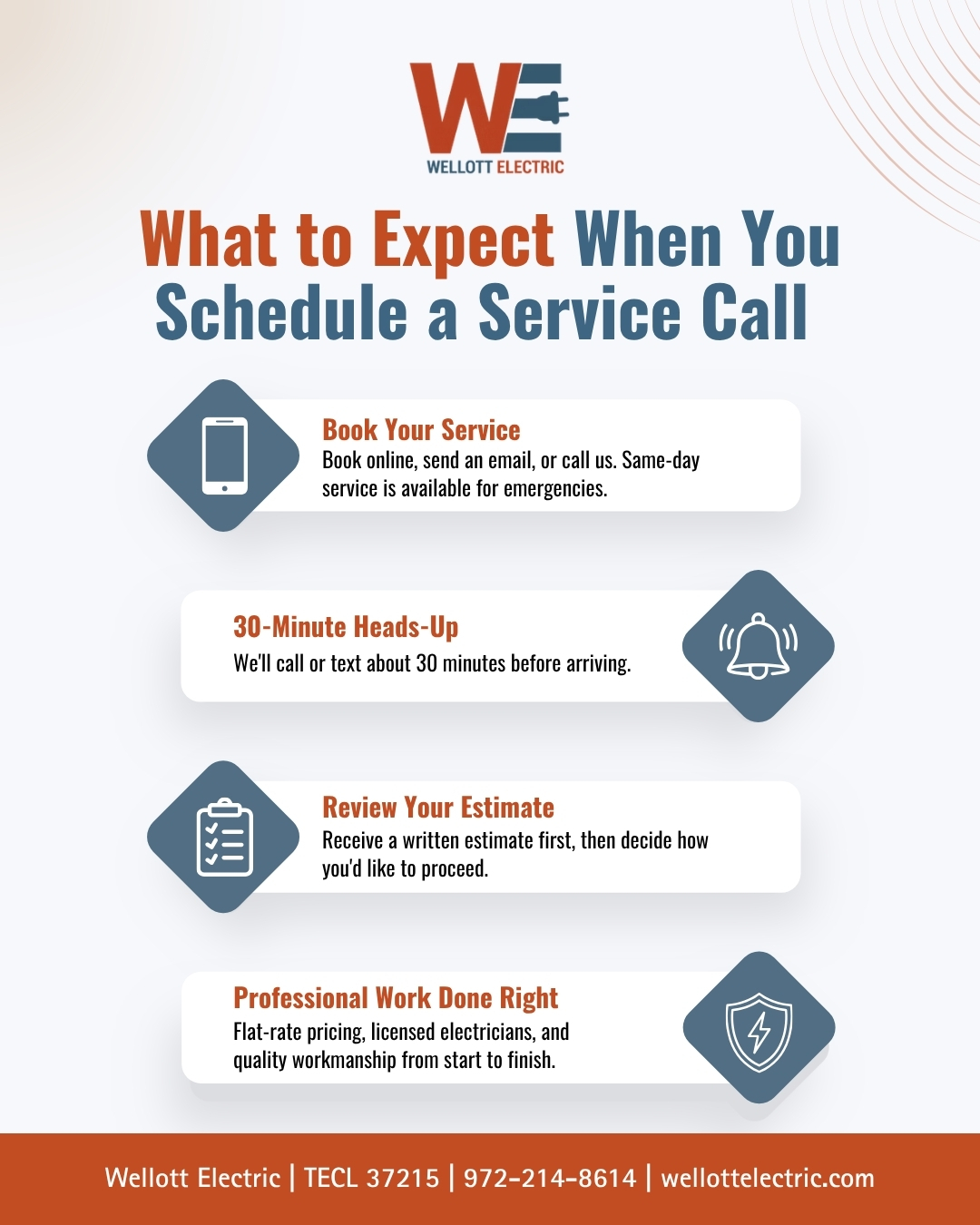
If you’ve never worked with us before, here’s exactly how a job goes, because knowing what to expect makes the whole thing easier. It starts with booking, and you’ve got three easy ways to do it: schedule online in a couple of minutes, email scheduling@wellottelectric.com, or call 972-214-8614. For emergencies, we respond the same day.
Before we arrive, you’ll get that signature 30-minute call or text ahead, so you’re never left guessing. Our licensed electrician evaluates the job on-site and gives you a clear, written estimate before any work begins. You decide, with zero pressure. Many service calls we can finish the same day, and larger projects get scheduled promptly based on scope. For troubleshooting and repairs, there’s a straightforward dispatch fee to get a licensed pro to your door, and you’ll always see the price in writing before we lift a tool. Start to finish, it’s built to be honest, respectful, and easy.
How Do I Get Started?
If anything here hits home- a breaker that won’t behave, a bill that makes you wince, a backyard that could be so much more in the evenings, or just the nagging thought that you’d like to be ready before the next storm- the easiest next step is to reach out. We’ll give you an honest look and a clear written price, with no pressure at all.