


 SCHEDULE NOW

A high summer electric bill is mostly your air conditioner working overtime in the Texas heat, which is normal. But the pattern can point to fixable things: aging, inefficient lighting, a superheated attic, tired appliances, or, less often, a wiring fault quietly wasting power. The electrical side has real levers, LED lighting and dimmers, ceiling and attic fans, smart controls, and finding faulty circuits. And if your bill jumped with no change in your habits, that’s worth having an electrician look at. Wellott Electric serves McKinney and all of Collin County. A real person answers, and you’ll have a written price before any work begins. Book at wellottelectric.com or call (972) 214-8614.
Your electric bill is the one place your home tells you, in plain numbers, how hard it’s working. Most of the year it hums along in the background. Then summer hits North Texas, the bill climbs, and a lot of homeowners feel that little jolt of “wait, why is it that high?”
Here’s the useful way to think about it: a summer bill isn’t just a cost, it’s data. Some of the increase is simply the season, and that part is normal and expected. But the size and the pattern of the jump can tell you something more specific about your home, what’s running efficiently, what’s quietly wasting energy, and once in a while, what might actually need attention. Learning to read it can save you real money and catch problems early.
This guide breaks down what a summer bill is actually telling you, in clear, no-jargon terms. We’ll cover what drives the cost, how to tell normal summer from a real signal, what an electrician can (and honestly can’t) do about it, and when a high bill is worth a closer look. We’re Wellott Electric, a family-owned company based in McKinney and serving Collin, Grayson, Fannin, and Hunt Counties, and helping homeowners understand this stuff is a big part of what we do. Let’s read your bill together.
One more thing before we start: this isn’t about guilt or doing without. Nobody should sweat through a Texas summer to save a few dollars. It’s about making sure the comfort you’re paying for is the comfort you’re actually getting, and that nothing in your home is quietly costing you more than it should. That’s a goal worth a few minutes of reading.
Why Is My Electric Bill So High in the Summer?
The short, honest answer is air conditioning. In a North Texas summer, cooling your home is by far the largest thing your electricity does. When it’s over 100 degrees outside and your AC is running in long cycles from morning to night, day after day, that steady, heavy demand is the main reason the bill climbs.
A few other summer factors stack on top. The days are longer, so lights and screens run more. The pool pump, if you have one, runs for hours. More people are home during summer break, opening the fridge, doing laundry, running the AC harder to keep up. None of this is a malfunction. It’s just what summer asks of a home, and almost every house in the area sees the same seasonal bump.
So a higher summer bill, on its own, isn’t a red flag. The question worth asking is how much higher, and whether the jump fits the weather, or runs ahead of it. That’s where the interesting part starts.
How Much Should a Summer Bill Actually Go Up?
There’s no single right number, because every home is different, your square footage, how old the house is, how efficient the AC is, how many people are home, and what the weather did that month all matter. But you can still get a useful sense of what’s normal for your home by looking at your own history.
The most reliable yardstick isn’t your neighbor’s bill or a number off the internet, it’s your own bill from the same month last year. If this July looks like last July, give or take, and the weather was similar, you’re probably in normal territory. A modest year-over-year rise often just tracks energy rates, which have generally crept up. What’s worth a closer look is a jump that’s clearly bigger than both the weather and the rate changes can explain.
So before you worry, pull up last summer’s bills and compare. That five-minute habit turns a vague “this feels high” into a clear answer, and it tells you whether you’re looking at ordinary summer or something worth addressing.
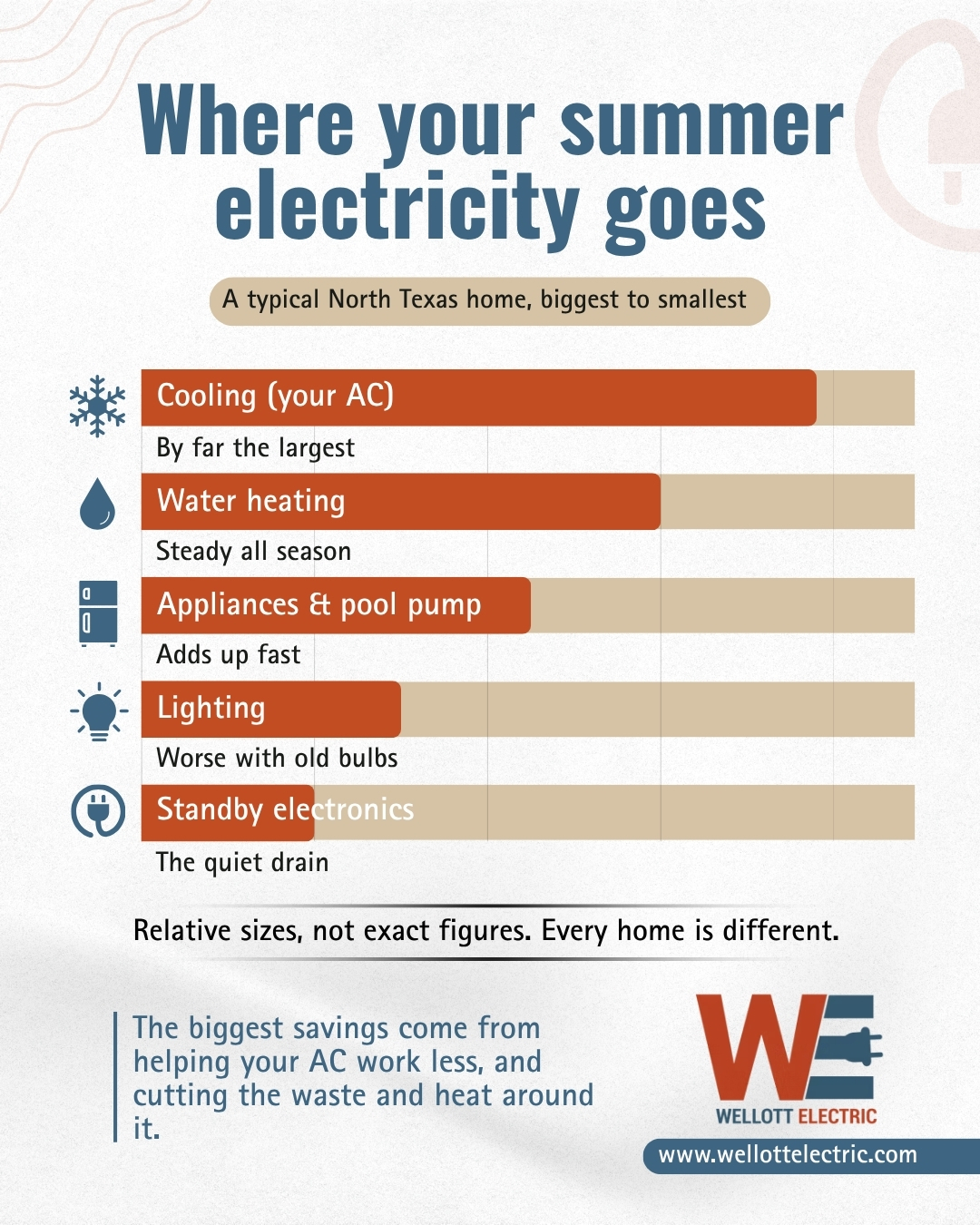
It helps to know roughly where the money goes, so you can focus on what actually matters. In a typical North Texas home during the summer, the order usually looks like this:
- Cooling, by a wide margin. Your AC is the heavyweight. Anything that helps it run less, or work less hard, has the biggest payoff.
- Water heating. Showers, laundry, and dishes add up, steadily, all season.
- Large appliances and the pool pump. The fridge, the second freezer in the hot garage, the dryer, and a pool pump running long summer hours all draw real power.
- Lighting. Older incandescent and halogen bulbs use far more energy than LEDs, and they give off heat your AC then has to remove, a double hit in summer.
- Always-on “phantom” loads. Electronics, chargers, and devices left in standby quietly sip power around the clock.
Notice the theme: the biggest savings come from helping your cooling work less hard and from trimming the things that waste energy and add heat. That’s exactly where a few smart electrical upgrades come in, which we’ll get to.
It’s also why chasing tiny savings, obsessing over a single lamp or a phone charger, misses the point. The real money is in the big, heat-related items: cooling, the heat your lighting throws off, and the heat your attic dumps into the house. Focus there, and the rest takes care of itself.
Do EV Chargers and Pools Really Spike Your Bill?
Two of the most common summer additions, an electric vehicle and a pool, do show up on the bill, and it helps to understand how. Charging an EV at home uses real energy; there’s no way around that, but it’s usually far cheaper per mile than gas, and charging overnight keeps it convenient and out of the hottest, highest-demand part of the day. The key is having a proper, dedicated circuit so it charges efficiently and safely rather than straining an old one.
A pool is the other big one. The pump is often one of the largest single draws in a summer home, especially if it runs long hours on an older, less efficient motor. The pump itself is pool-equipment territory, but the circuit and wiring feeding it are ours, and making sure it’s on the right dedicated circuit, properly protected, keeps it running safely without waste. Smart timers help here too, so it runs only as long as it needs to.
Neither of these should be a mystery on your bill once you know they’re there. If you’re adding an EV charger installation or a pool this summer, getting the electrical right from the start keeps the cost predictable and the setup safe.
The Part of Your Bill That’s Just Summer
Before we go hunting for problems, it’s worth saying plainly: a chunk of your summer increase is completely normal, and no amount of upgrades will erase it. You live in North Texas, and keeping a home cool through July and August costs money. That’s the baseline.
The goal isn’t to make a summer bill look like a spring bill. It’s to make sure you’re not paying extra on top of the normal summer cost for inefficiency, waste, or a hidden issue. So as you read the rest of this, keep that frame: we’re looking for the part of the bill that’s above and beyond what the season alone explains.
Keeping that perspective also keeps the whole thing low-stress. You’re not trying to win some battle against your bill. You’re just making sure your home runs the way it should, so you’re paying for the comfort you actually use and nothing more. That’s an achievable, satisfying goal, and you may be surprised how much a few sensible changes help.
Why Did My Bill Jump More Than the Heat Did?
This is the question that actually matters, and it’s the one your bill can help you answer. If your usage climbs roughly in step with the temperature, year over year, that’s normal. If it jumps noticeably more than the weather did, or more than it did last summer for the same months, that’s a signal worth paying attention to.
A few patterns tend to point to something fixable rather than just the season:
- A bill that’s well above the same month last year, even though the weather and your habits are about the same.
- Rooms that never quite cool down, so the AC runs almost constantly, trying to catch up, which is expensive.
- A sudden spike with no change in how you’re living, which can point to a failing appliance or, occasionally, an electrical fault.
- Lights and fixtures that run hot are a sign of older, inefficient bulbs, adding both cost and heat.
If one or two of these sound familiar, the good news is they’re usually addressable. The rest of this guide is about what’s behind them and what to do.
The Hidden Cost of an AC That Can’t Keep Up
One of the most expensive patterns in a summer home is an air conditioner that runs almost without stopping and still can’t quite get there. When the AC never reaches the temperature you set, it just keeps running, and a system that runs constantly is a system that costs constantly.
Sometimes the cause is purely the cooling system, which is an HVAC matter. But the electrical side plays a role more often than people realize. Heat pouring down from an unventilated attic makes the AC fight a losing battle, which is where attic exhaust fans help. Old, heat-throwing light fixtures add to the load room by room. And in some homes, an overworked panel or a tired circuit means the system can’t run as cleanly and steadily as it should.
The takeaway is that comfort and cost are linked. A home that holds its temperature easily is a home that isn’t burning money to stay cool. If certain rooms never settle, or the AC seems to run forever, it’s worth looking at the whole picture, cooling and electrical together, rather than just accepting a high bill as the price of summer.
This is also why the cheapest upgrades are sometimes the ones that help your cooling most. Getting heat out of the attic and off your ceilings does more for a struggling AC than people expect, and it costs far less than replacing the system. Small electrical moves can take real pressure off the biggest number on your bill.
When a summer bill runs higher than it should, the cause is usually one or more of these, none of them dramatic, all of them worth knowing about.
Old, inefficient lighting
Incandescent and halogen bulbs turn a lot of their energy into heat instead of light. In summer, that’s the worst of both worlds: you pay to run them, then pay again to cool the heat they throw off. Switching to LED lighting is one of the simplest ways to cut waste, and modern LEDs look great on dimmers.
A superheated attic
On a hot afternoon, an attic can pass 130 or 150 degrees, and that heat radiates down into your living space and forces the AC to work harder. Proper attic exhaust fans pull that heat out and take a real load off your cooling, often one of the most overlooked summer savings there is.
Aging appliances and a hard-working pool pump
An older fridge, a second freezer in a hot garage, or a pool pump running long hours can all draw more than you’d expect. Appliances also lose efficiency as they age. These aren’t always an electrician’s fix, but they’re often part of the picture, and worth knowing about when you read your bill.
Phantom loads and constant draws
Devices left in standby, chargers, and always-on electronics add a small, constant draw that runs up the meter quietly. Smart switches and timers can help shut these off when they’re not needed.
Faulty wiring or a failing circuit
This one’s less common, but it’s the reason a high bill is sometimes worth a real look. A short, a ground fault, or a failing connection can waste energy and, more importantly, create a safety risk. If your bill spikes with no other explanation, having an electrician check the wiring and circuits is a smart move, for your wallet and your safety both.
The good news is that for most homes, the drivers are the ordinary ones, lighting, attic heat, aging appliances, standby draws, and those are all improvable. The wiring issues are the exception, not the rule. But knowing they exist is what turns your bill from a number you dread into a tool that can flag a real problem early, while it’s still small.
Why Is My Bill High Even When I’m Barely Home?
This one surprises people. You travel for a week, or you’re gone most days, and the bill still comes in high. How? The answer is that a lot of a summer home’s energy use happens whether you’re there or not.
Your air conditioner still runs to keep the house from baking, even at a higher hold temperature. The refrigerator and any garage freezer run around the clock. The pool pump keeps its schedule. And all those phantom loads, electronics and chargers in standby, keep sipping power with no one home. None of that pauses when you leave.
The fixable part is real, though. A smart thermostat lets the house drift warmer while you’re away and cool down before you return, so you’re not paying to chill empty rooms at full blast. Smart switches and timers shut off the lights and devices that don’t need to run. And making sure the always-on appliances are efficient and on healthy circuits keeps that baseline draw as low as it can be. A home that’s smart about its empty hours is a home that costs less to own.
Does an Old Electrical Panel Raise Your Electric Bill?
This is a common question, and the honest answer is: not directly. Your electrical panel doesn’t consume power itself, it just distributes it. So simply having an older panel won’t, by itself, make your meter spin faster.
But there’s nuance worth understanding. An undersized or aging panel can struggle to keep up with a modern home’s summer load, which shows up as tripping breakers, dimming lights, and an AC that fights to run steadily, and a system that can’t run cleanly often isn’t running efficiently. More to the point, an outdated panel can hold you back from the upgrades that genuinely do lower your usage: it may not have room for smart circuits, efficient additions, or the dedicated wiring those improvements need.
So while a panel upgrade isn’t an energy-savings product on its own, it’s frequently the thing that clears the way for the changes that are. We’ll always tell you honestly where a panel fits into your particular situation, rather than selling it as a magic fix for a high bill.
If your panel is keeping up fine, we’ll say so and leave it alone. If it’s genuinely holding your home back, struggling under the summer load or out of room for the upgrades you want, we’ll explain exactly why and what it would take to fix. The point is to match the work to your home’s real needs, not to a sales target.
Summer Bills in Older Homes
If your home was built in the 1980s or 1990s, and a lot of homes across Collin County were, summer bills can be a little higher for reasons that are entirely fixable. Older homes were built for the lighting, appliances, and habits of their time, and they often still have the inefficient pieces to match.
The usual suspects in an older home are incandescent and halogen lighting throwing heat, an attic with little or no powered ventilation, original fixtures and switches with no dimming or smart control, and an aging panel that limits what you can add. None of that means anything is wrong, it just means there’s room to modernize. A round of efficiency-minded updates, LED lighting, attic fans, dimmers and smart switches, makes an older home noticeably more comfortable and easier on the bill, without changing the character you love about it.
Newer homes usually start more efficient, but they benefit from the smart-control and ventilation upgrades too. Whichever era your house is from, the same principle holds: find the waste, fix it once, and enjoy the savings every summer after.
Can an Electrician Lower My Electric Bill?
Yes, within reason, and it’s worth being straight about how. An electrician isn’t your HVAC company, so we’re not the ones tuning up the air conditioner that drives most of your summer cost. What we can do is reduce the waste around it and help your home run more efficiently, which adds up over a long Texas summer.
The honest framing is this: there’s no single switch that slashes a bill in half. But a handful of targeted electrical upgrades, done together, make a real and lasting difference, and several of them improve comfort and safety at the same time. That’s the part worth investing in, and it’s the part we can help with directly.
What we won’t do is oversell it. If we look at your home and the honest answer is that your bill is mostly just summer and your setup is already efficient, we’ll tell you that and save you the money. And if there are clear wins on the table, we’ll lay them out plainly, with a written price, and let you choose. Either way, you leave the conversation knowing exactly where you stand.
The Upgrades That Actually Move the Needle
If you want to spend money where it actually helps, these are the electrical upgrades with the best return over a North Texas summer.
- LED lighting and dimmers. A whole-home switch to LED cuts lighting energy sharply and removes heat from your rooms. Dimmers trim it further and let you run lights low during the bright part of the day.
- Ceiling fans. Fans let you raise the thermostat a couple of degrees while feeling just as cool, and that small change works in your favor every single day of the summer.
- Attic exhaust fans. Moving superheated air out of the attic takes a direct load off your AC, which is the biggest number on the bill.
- A smart thermostat and smart switches. Cooling on a schedule, easing back while you’re out, and automating lights and fans all cut waste. Many smart thermostats need a common wire, or C-wire, that older homes lack, and we can add it.
- Fixing faulty circuits. Finding and repairing a wiring issue that’s wasting energy saves money and removes a safety risk at the same time.
You don’t have to do all of these at once, either. Many homeowners start with the quick, low-cost wins, LED lighting and a couple of fans, then add the bigger pieces like attic ventilation or a smart thermostat over time, or bundle them into a project that’s already happening. There’s no wrong order, only the order that fits your home and budget.
We’re glad to walk your home and point out which of these would help you most, in plain terms, with no pressure. That kind of straight, no-upsell advice is what folks tend to mention in our reviews; one recent homeowner wrote that our tech, rather than pushing extra work, “was more about helping us be prepared and budget” for what they actually needed. You’ll always get a written price before anything begins.
A Room-by-Room Look at Summer Energy Waste
Sometimes it’s easier to spot waste by walking through the house. Here’s where summer energy tends to leak in a typical North Texas home, room by room.
- The kitchen. Old can lights and fixtures throwing heat, plus a fridge that’s getting on in years, make the kitchen a quiet energy hog. LED recessed lighting is a clean fix that also looks great.
- The garage. That second fridge or freezer in an un-airconditioned garage works overtime in summer heat, drawing more than you’d guess. It’s worth knowing it’s there on the bill.
- The attic above it all. Not a room you live in, but the hottest space in the house, and the heat it traps radiates into every room below. Ventilation here pays off everywhere.
- The living room. Entertainment centers, game consoles, and chargers draw power in standby around the clock. Smart switches and power management trim that quiet, constant draw.
- Outdoors. A pool pump running long hours and older landscape lighting both add up over a summer. Efficient fixtures and smart timers keep them from running more than they need to.
You don’t have to tackle all of it at once. Walking the house this way just helps you see where your money is going, so you can start with the rooms that would save you the most.
Most of the time, a summer bill is just summer. But there are a few situations where it’s genuinely worth picking up the phone, because the bill may be pointing at a problem rather than the season. None of this is meant to alarm you, it’s just useful to know the difference between an expensive month and an actual issue.
- A sudden, unexplained spike. If usage jumps sharply with no change in weather or habits, something changed. It could be a failing appliance or an electrical fault drawing current it shouldn’t.
- Breakers tripping along with the higher bill. A struggling circuit that trips and a climbing bill can be related, and both deserve a look.
- Warm outlets or switch plates, buzzing, or a faint burning smell. These point to a wiring issue, and they’re a safety matter first. Stop using the circuit and call a licensed electrician promptly.
In these cases, the bill is doing you a favor by flagging something early. A quick diagnostic visit can find the cause, and we’ll tell you honestly whether it’s a real issue or just the heat. Either way, you’ll know.
And catching these things early almost always means a smaller, simpler fix. A worn connection found now is a quick repair; the same issue ignored for months can turn into something bigger. That’s the quiet value of paying a little attention to your bill, it lets you act while problems are still little.
Does a Whole-Home Generator Add to Your Bill?
Homeowners considering backup power often ask this, and it’s a fair question. The honest answer is reassuring: a standby generator has very little effect on your everyday electric bill.
Here’s why. A whole-home standby generator sits in standby most of the time, drawing almost nothing. It runs a brief self-test now and then to stay ready, which uses a small amount of fuel, not a meaningful amount of grid power. And when it actually runs during an outage, it’s powering your home on natural gas or propane, not on electricity from the grid, so it isn’t adding to the electric bill at all during those hours.
In other words, a generator is about reliability, not a line item that spikes your monthly usage. As an authorized Generac generator dealer, we’re glad to walk you through the real costs of owning one, the unit, the install, the fuel, and the occasional service, so there are no surprises. You can browse models and request a quote any time.
How to Read Your Bill Like a Pro
A few simple habits make your bill genuinely useful instead of just stressful. None of this takes more than a minute or two each month.
- Watch the kilowatt-hours, not only the dollars. Rates change, so the dollar amount can move even when your usage didn’t. The kWh number tells you what your home actually used.
- Compare the same month, year over year. July to July is a fair comparison. A big jump for the same month, in similar weather, is worth a second look.
- Note anything that doesn’t fit. A spike during a mild stretch, or usage that keeps climbing when nothing changed, is the kind of anomaly worth investigating.
- Check your plan and rate. Sometimes a higher bill is partly a rate or plan change rather than your home, and it’s good to know which you’re dealing with.
Read this way, your bill becomes an early-warning system and a guide to where upgrades would pay off, instead of a once-a-month surprise.
What to Do First if Your Bill Is Too High
If you’ve decided your summer bill is running higher than it should, here’s a sensible order to work through it, from the free and easy to the worth-calling-a-pro.
- Start by comparing. Pull last summer’s bills for the same months and look at the kilowatt-hours. This tells you whether you’re dealing with normal summer, a rate change, or a real increase in usage.
- Knock out the easy wins. Swap your most-used bulbs for LEDs, use ceiling fans so you can ease up on the thermostat, and unplug or power-manage the electronics that sit in standby. Small, immediate, no-regret moves.
- Look at the bigger levers. If the easy wins aren’t enough, the higher-impact upgrades, attic ventilation, a smart thermostat, dimmers and smart switches, whole-home LED, are where the lasting savings live.
- Rule out a problem. If the bill spiked suddenly, or it comes with tripping breakers or warm outlets, have an electrician check for a fault before anything else. That’s a safety and a savings issue at once.
Not sure where your home falls on that list? That’s exactly the kind of thing we’ll sort out with you. A quick visit gives you a clear, honest read and a written price, so you can decide what’s worth doing. Book whenever it’s convenient.
Here’s the encouraging part. No single upgrade transforms a bill, but a few sensible ones, done together, add up to a noticeable difference over the hottest months, and they keep paying off summer after summer. LED lighting, a couple of ceiling fans, attic ventilation, and smarter controls aren’t dramatic on their own. Stacked together and running all season, they add real value, and they make the home more comfortable while they’re at it.
Better still, most of these are quick to install and easy to bundle. If we’re already at your home for one project, adding a few of the others while we’re there is simple, and it saves you a second visit. Summer is the season they earn their keep, which makes right now a smart time to put them in.
And it isn’t only about savings; the comfort side is real too. A home with good lighting, working fans, a cooler attic, and smart controls simply feels better to live in through a long, hot stretch. You notice it every day, in rooms that stay comfortable and a house that doesn’t feel like it’s straining against the heat. That’s the part that doesn’t show up on the bill but matters just as much.
The Long Game: Upgrades That Pay for Themselves
It’s natural to weigh the cost of an upgrade against the savings, and that’s the right way to think about it. The useful part is that several of these improvements aren’t one-summer purchases; they keep paying you back, summer after summer, for as long as you own the home.
LED lighting is the clearest example: install it once, and it sips energy and lasts for years, quietly trimming the bill every month while rarely needing a bulb change. Attic ventilation keeps easing your cooling load every hot season. A smart thermostat keeps optimizing your cooling automatically, day after day, without you lifting a finger. Even fans, once they’re up, let you run warmer thermostat settings for years to come.
Stacked together, these turn into a home that simply costs less to run, and they tend to make a home more appealing if you ever sell, too. That’s the difference between a repair, which fixes a problem, and an efficiency upgrade, which keeps giving back. When you’re deciding where to put your money, the upgrades that pay for themselves over time are usually the smartest place to start.
How We Help
When you’re ready to do something about your bill, we make it easy. We’ll come out, look at your home, and give you a clear, honest read on where your energy is going and which changes would actually help, no scare tactics, no upselling. You’ll get a written, transparent price before any work starts, and you decide from there.
You’re working with a local, family-owned team that knows North Texas homes and North Texas summers. A real person answers when you call, we schedule around your day with a four-hour window and a heads-up before we arrive, and our emergency service line is open around the clock for the things that can’t wait. It’s the kind of straightforward, neighborly service one recent reviewer summed up as “fast, professional” work at a fair price, and it’s how we treat every home across Collin County.
We’ve earned a 5-star rating across 475 Google reviews, a BBB A+ rating, and Nextdoor Neighborhood Fave recognition every year from 2022 through 2025, the kind of trust you build one honest job at a time.
Whether it turns out you need a single smart thermostat and a few LEDs, or a fuller round of efficiency upgrades, you’ll get the same honest guidance and the same easy experience. We’d rather earn a customer for the long haul than oversell one project, and a summer bill is a good, low-pressure place to start that relationship.
Talk to a Local Electrician
Your summer bill doesn’t have to be a mystery or a monthly frustration. Once you know what it’s telling you, you can act on the part that’s fixable and stop paying for waste. If you’d like a straight, local read on where your energy is going and what would actually help, we’re glad to take a look.